2025
Co-author
Distributed Systems Lab, University of Pennsylvania
Xuting Liu, Daniel Alexander, Siva Kesava Reddy Kakarla, Behnaz Arzani, Vincent Liu
Python, PyTorch, CUDA, Sarathi Framework
Preprint, under revision
DREX — Dynamic Rebatching for Early-Exit LLM Inference
Xuting Liu, Daniel Alexander, Siva Kesava Reddy Kakarla, Behnaz Arzani, Vincent Liu · Preprint, under revision · arXiv:2512.15705
The System
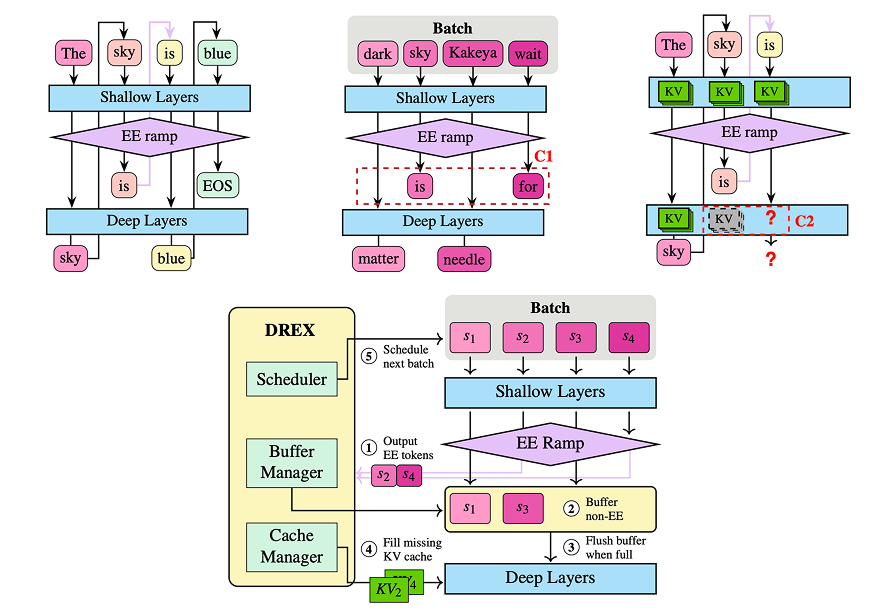
Early-Exit (EE) LLMs accelerate inference by generating easier tokens with only a subset of the model's layers. Traditional batching frameworks are ill-suited to this, because not all requests in a batch are ready to exit at the same time. Existing solutions either force a uniform decision on the whole batch, which overlooks early-exit opportunities, or force premature exits, which degrades output quality.
DREX introduces Dynamic Rebatching: at each early-exit point, requests that meet the exit criteria are processed immediately, while those that continue are buffered, regrouped into a new batch, and forwarded to deeper layers. DREX implements this with two key optimizations: a copy-free rebatching buffer that avoids physical data movement, and an EE- and SLA-aware scheduler that analytically predicts whether a given rebatching operation will be profitable. It also handles the KV cache missing from skipped layers with memory-efficient state copying. DREX improves throughput by 2–12% over baseline approaches while maintaining output quality, and completely eliminates involuntary exits.
My Contributions
- System implementation: contributed to the design and implementation of dynamic rebatching on the Sarathi serving framework, implemented an efficient batch-wise KV-cache copying mechanism, and implemented BERTScore as an output-quality metric.
- Experimental evaluation: extended the experimental suite to NVIDIA A100, H200, RTX 3090 Ti, and RTX 5090 GPUs running Llama 2 7B, 13B, and 70B and Qwen 14B models, and introduced new workloads, including HumanEval for code generation and XSum for abstractive summarization.
- Technical communication: contributed to the paper's writing, generated key experimental figures in PGFPlots (throughput vs. confidence threshold, early-exit proportion breakdowns, and memory efficiency), and adapted design figures to TikZ.